Wiki
Little Walter Jacobs
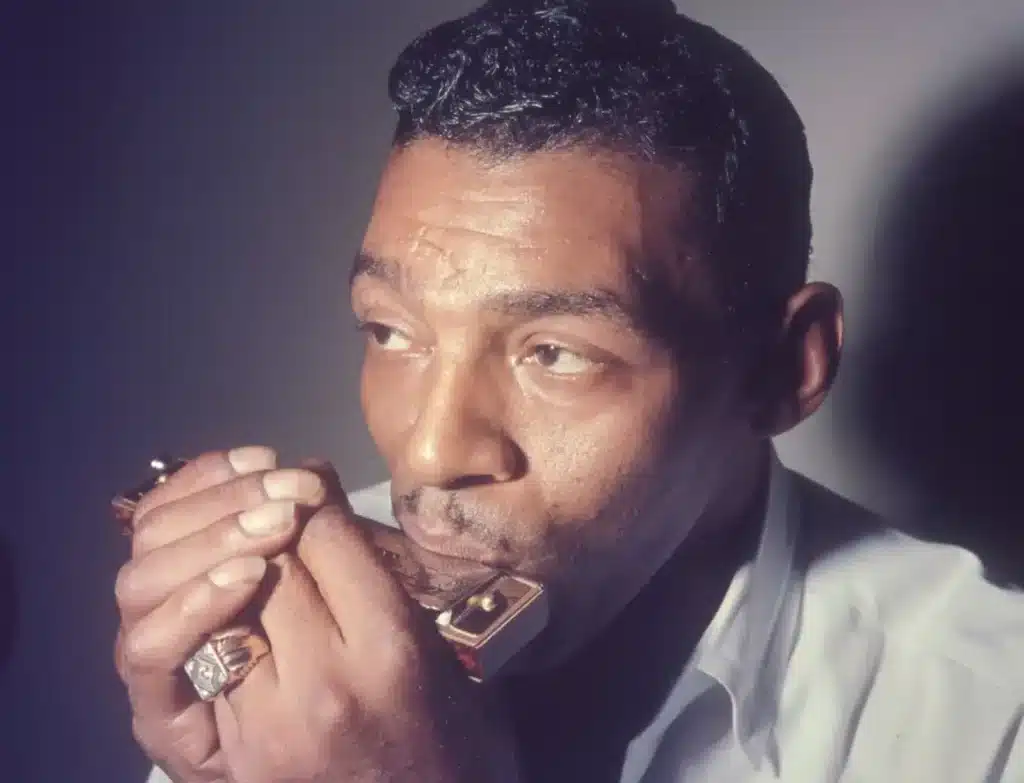
Little Walter Jacobs (1930-1968)
Marion Walter Jacobs, best known as “Little Walter” was a Chicago Blues singer, songwriter, and virtuoso harmonica player. He is considered “the king of all the post-war blues harpists.”
His nickname was “Little”, his influence was “Huge”! Born Marion Walter Jacobs, known professionally as Little Walter, was born in Marksville, LA. Raised in Rapides Parish, LA, quit school at age 12, worked odd jobs and played in the streets in New Orleans, Memphis, Arkansas and St. Louis before he migrated to Chicago, IL in 1946.
Little Walter played guitar but is best known for his blues harmonica style, which he developed while playing along with older bluesmen such as Sonny Boy Williamson II, Sunnyland Slim and Honeyboy Edwards, and was influenced by Sonny Boy Williamson I. Jacobs was frustrated with his harmonica (aka “harp” in the blues world) being drowned out by the electric guitars, so he cupped a small microphone in his hands with the harmonica to increase his volume thru a PA or guitar amp. Although not the first blues harp player to cup the mic or use an amp, he was the first to push the amp beyond its technical limits, thus creating distortion, previously unheard from any harmonica musician.
His first recordings were released in 1947 on the tiny Ora-Nelle label, which operated out of the back room of Abrams’ Maxwell Radio Records Store on Maxwell St. in Chicago. He also recorded a few sides on the Regal and Chance labels in Chicago. Little Walter joined Muddy Waters band in 1948 and by 1950 became a session man playing harp on Muddy Waters early recordings released on Chess Records. Little Walter also played guitar on a few recordings on the Parkway label with Baby Face Leroy and Muddy Waters in Chicago around this time.
Walter became a solo artist on the Chess subsidiary Checker Records in 1952 and released 14 Top 10 R&B hits during his career. Little Walter’s harmonica playing influenced many practitioners including Junior Wells, James Cotton, Kim Wilson, and Paul Butterfield.
Important Songs:
“Juke” was his first single, written by Dixon, and was the first instrumental harp song to reach No.1 on the R&B Charts and secured Chess future for many years. “Juke”, is still the only harmonica instrumental ever to be a No.1 hit on the Billboard R&B chart. “My Babe” released became the first No.1 hit written by Willie Dixon (and Dixon’s only No.1 in the USA) and has been covered by many artists including his Checker label-mate Dale Hawkins, who put a rockabilly spin on it. “Boom, Boom, Out go the Lights” was released by Walter in 1957 and was covered by Pat Travers, who hit the Billboard Top 20 in 1979 and his live version became a classic rock anthem on FM radio. “Blues With a Feeling” went to No.2 on the R&B charts in 1953 and Little Walter’s adaptation has been identified as a blues standard and “a necessary passage” of every beginning harmonica and is one of his most covered songs.